 A Huge Thank You to Bob (my brother) and Becky (his girlfriend) for getting us this wonderful 4-in-1 convertible crib. I can't wait till it arrives to start setting up the baby's things. Brian and I are very happy and excited. You will make a great uncle. Wished you both (well the baby too) lived closer ... maybe one day soon. Give Rachael Morgan a kiss and hug from Uncle Brian and Aunt Hannah. Send some pictures too. I am sure she is growing like a weed.
Sunday, March 9, 2008
The Crib...Thank you Bob & Becky
A Huge Thank You to Bob (my brother) and Becky (his girlfriend) for getting us this wonderful 4-in-1 convertible crib. I can't wait till it arrives to start setting up the baby's things. Brian and I are very happy and excited. You will make a great uncle. Wished you both (well the baby too) lived closer ... maybe one day soon. Give Rachael Morgan a kiss and hug from Uncle Brian and Aunt Hannah. Send some pictures too. I am sure she is growing like a weed.

Saturday, March 8, 2008
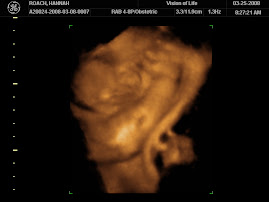
Well this is Abigail

.. or what you can see of her. She absolutely didn't want her pictures being taken so much so that they are going to let me come in again on 3/25/08 for another session at no charge. What you see here is two feet in front of her face covering up her eyes with the nose in between. We saw a lot of her ears and arm... LOL oh well we will try again in two weeks.
Friday, March 7, 2008
Ultrasound 3D

While this is not Abigail's 3D .... I will put hers up. A big Thank You to Johnna and Edward F. for contributing to a 3D ultrasound which we otherwise would not have done due to cost. At 4 PM on 3/8 we go in for an ultrasound... We are both so excited.
This is what we will recieve in the ultrasound package tomorrow:
• Complete 30+ minute Ultrasound Session
• DVD video of your ultrasound including: 2D, 3D & 4D segments (as appropriate), set to music
• 4 Black and White 4x4 “thermal” images
• Sex Determination* (Upon request)
• 4 colorized portraits of your baby/babies.
• CD with 15-30 high-resolution 3D still images suitable for printing and emailing to family and friends.
• One year FREE access to BabyPeeks™, a customized online Baby Website. Everything you need to share your pregnancy experience with friends and family online! ($49.95 value)I will post some of the ultrasound pics as soon as we get them.
Moby Wrap

A big thank you to Gaile and Benson M. for the Moby Wrap. They got me this in the color chocolate, which is what I wanted. Thanks Again guys.
Happenings on 3/10 and 3/11
On 3/10 I go in at 10:15 AM for my first iron shot and my first Betamethasone shot (this shot is to develope Abigail's lungs) Brian and I also have our second of five prenatal classes Monday from 6:30 to 8:30
On 3/11 I go in at 2:30 PM for my second Betamethasone shot. (I am guessing I only have two of these). They will also set me up for my weekly Non Stress Test... What is this you are asking? well here is what a NST includes.
What is a nonstress test?
This simple, painless procedure is done during pregnancy to evaluate your baby's condition. During the test, your healthcare practitioner or a technician monitors your baby's heartbeat, first while the baby is resting and then while he's moving. Just as your heart beats faster when you're active, your baby's heart rate should go up while he's moving or kicking.The test is typically done if you've gone past your due date, or in the month leading up to your due date if you're having a high-risk pregnancy. Here are some reasons you might have a nonstress test:
• You have diabetes that's treated with insulin, high blood pressure, or some other medical condition that could affect your pregnancy.
• You have gestational hypertension.
• Your baby appears to be small or not growing properly.
• Your baby is less active than normal.
• You have too much or too little amniotic fluid.
• You've had a procedure such as an external cephalic version (to turn a breech baby) or third trimester amniocentesis (to determine whether your baby's lungs are mature enough for birth or to rule out a uterine infection). Afterward, your practitioner will order a nonstress test to make sure that your baby's doing well.
• You're past your due date and your practitioner wants to see how your baby is holding up during his extended stay in the womb.
• You've previously lost a baby in the second half of pregnancy, for an unknown reason or because of a problem that might happen again in this pregnancy. In this case, nonstress testing may start as early as 28 weeks. (Mine is starting at 30 Weeks)
What's the procedure like?
You may be advised to eat a meal just before the test in the hope that eating will stimulate your baby to move around more. Although there's no hard evidence that this works, it can't hurt. It's also a good idea to use the bathroom before the test, because you'll be lying strapped to a monitor for up to an hour.During the procedure, you lie on your left side, possibly with a wedge under your back that allows you to lean back. A technician straps two devices to your belly: One monitors your baby's heartbeat and movement; the other records contractions in your uterus. The technician listens to and watches your baby's heartbeat on an electronic screen while your contractions are recorded on paper.If your baby's not moving, he could be asleep. You might be asked to drink some water, juice, or soda to get him going, or the technician may nudge him gently through your abdomen or try to wake him with a buzzer. In some cases, you'll be asked to press a button when you feel the baby move. The test usually takes 20 to 60 minutes.
What do the results mean? If your baby's heart beats faster (at least 15 beats per minute over his resting rate) while he's moving for at least 15 seconds on two separate occasions during a 20-minute span, the result is normal, or "reactive." A normal result means that your baby is probably doing fine for now. Your practitioner may want to repeat the test every week (or more often) until your baby's born.If your baby's heart doesn't beat faster while he's moving or your baby doesn't move after about 90 minutes, the result is "nonreactive." A nonreactive result doesn't necessarily mean something is wrong. It just means that the test didn't provide enough information and you may need to take it again in an hour or take other tests such as a biophysical profile or contraction stress test.However, a nonreactive result could indicate that your baby isn't getting enough oxygen or that there are problems with the placenta. If your practitioner thinks that your baby's no longer doing well in the womb, she'll probably decide to induce labor.
Why does the test measure contractions, and why would I be having them?
For several reasons. First, you may or may not be having contractions at this point in your pregnancy. If you are, they could be Braxton-Hicks contractions, which are usually mild, irregular, and sporadic. These are harmless and common during the third trimester. But if you're less than 37 weeks pregnant and you're having continuous, repetitive, regular contractions, it could be a sign of preterm labor, and your practitioner will want to evaluate your cervix to see if it's dilated.Another reason to monitor contractions is to see whether your baby's heart rate changes when you're having them. That's what's measured during a contraction stress test. If the heart rate drops during a contraction, it may be a sign that that there's a problem with your placenta and that your baby's oxygen supply is compromised.
On 3/11 I go in at 2:30 PM for my second Betamethasone shot. (I am guessing I only have two of these). They will also set me up for my weekly Non Stress Test... What is this you are asking? well here is what a NST includes.
What is a nonstress test?
This simple, painless procedure is done during pregnancy to evaluate your baby's condition. During the test, your healthcare practitioner or a technician monitors your baby's heartbeat, first while the baby is resting and then while he's moving. Just as your heart beats faster when you're active, your baby's heart rate should go up while he's moving or kicking.The test is typically done if you've gone past your due date, or in the month leading up to your due date if you're having a high-risk pregnancy. Here are some reasons you might have a nonstress test:
• You have diabetes that's treated with insulin, high blood pressure, or some other medical condition that could affect your pregnancy.
• You have gestational hypertension.
• Your baby appears to be small or not growing properly.
• Your baby is less active than normal.
• You have too much or too little amniotic fluid.
• You've had a procedure such as an external cephalic version (to turn a breech baby) or third trimester amniocentesis (to determine whether your baby's lungs are mature enough for birth or to rule out a uterine infection). Afterward, your practitioner will order a nonstress test to make sure that your baby's doing well.
• You're past your due date and your practitioner wants to see how your baby is holding up during his extended stay in the womb.
• You've previously lost a baby in the second half of pregnancy, for an unknown reason or because of a problem that might happen again in this pregnancy. In this case, nonstress testing may start as early as 28 weeks. (Mine is starting at 30 Weeks)
What's the procedure like?
You may be advised to eat a meal just before the test in the hope that eating will stimulate your baby to move around more. Although there's no hard evidence that this works, it can't hurt. It's also a good idea to use the bathroom before the test, because you'll be lying strapped to a monitor for up to an hour.During the procedure, you lie on your left side, possibly with a wedge under your back that allows you to lean back. A technician straps two devices to your belly: One monitors your baby's heartbeat and movement; the other records contractions in your uterus. The technician listens to and watches your baby's heartbeat on an electronic screen while your contractions are recorded on paper.If your baby's not moving, he could be asleep. You might be asked to drink some water, juice, or soda to get him going, or the technician may nudge him gently through your abdomen or try to wake him with a buzzer. In some cases, you'll be asked to press a button when you feel the baby move. The test usually takes 20 to 60 minutes.
What do the results mean? If your baby's heart beats faster (at least 15 beats per minute over his resting rate) while he's moving for at least 15 seconds on two separate occasions during a 20-minute span, the result is normal, or "reactive." A normal result means that your baby is probably doing fine for now. Your practitioner may want to repeat the test every week (or more often) until your baby's born.If your baby's heart doesn't beat faster while he's moving or your baby doesn't move after about 90 minutes, the result is "nonreactive." A nonreactive result doesn't necessarily mean something is wrong. It just means that the test didn't provide enough information and you may need to take it again in an hour or take other tests such as a biophysical profile or contraction stress test.However, a nonreactive result could indicate that your baby isn't getting enough oxygen or that there are problems with the placenta. If your practitioner thinks that your baby's no longer doing well in the womb, she'll probably decide to induce labor.
Why does the test measure contractions, and why would I be having them?
For several reasons. First, you may or may not be having contractions at this point in your pregnancy. If you are, they could be Braxton-Hicks contractions, which are usually mild, irregular, and sporadic. These are harmless and common during the third trimester. But if you're less than 37 weeks pregnant and you're having continuous, repetitive, regular contractions, it could be a sign of preterm labor, and your practitioner will want to evaluate your cervix to see if it's dilated.Another reason to monitor contractions is to see whether your baby's heart rate changes when you're having them. That's what's measured during a contraction stress test. If the heart rate drops during a contraction, it may be a sign that that there's a problem with your placenta and that your baby's oxygen supply is compromised.
Tuesday, March 4, 2008
OK I had the glucose test on Friday... It was a tad bit high... 124 ..it should have been under 120, but the Dr. was not too worried about that. There were other things to worry about. I gained 7 lbs (no worry here) I had lost 12.... got those back and gained 7 more..... but that has all happened since about week 19 with the first 12... that I lost. Mi iron level was at 9.6 at the last appointment and it was 8.3 at this one. I went in after the appointment to the Hospital's lab for more blood work relating to my iron. Dr. Rivera really isn't happy to see that I have continued to drop. I go in on Monday morning and Tues afternoon to receive iron shots both days. He is concerned with the following things:
My previous six miscarriages,
Fertility issues
My endometerosis and laperoscopies
(this pregnancy)= HIGH RISK on the above factors and the factors below
My low level and continuously dropping iron levels
My low progesterone in the beginning that had to be taken to "help carry" the baby past the 12 weeks.
I will be starting in two weeks (if I understood him correctly) weekly NST and weekly pelvic exams. He is concerned with the placenta not doing it's job for the full nine months; based on all the above reasons. He will be ordering the steroids to give the baby to mature the lungs if the NST looks off and it looks like the placenta is not going to hold out. He isn't big on C- sections... glad to hear that but said a healthy baby if taken early was the goal. If It looks like through the NST(provided they come back good) and the increase of iron the baby will go full term otherwise he is looking and telling us to be prepared to have the baby taken between 35-37 weeks. I totally agree that I want a healthy baby above all out of this pregnancy even if I am scared to death of any potential problems. I would ask that everyone here be in prayer for Brian and I as we may - and I hope not, but for any issues or problems that may be encountered over the next 4-6 weeks. I have 11 weeks left if the baby were to be on time, but we are aware that Abigail may have to be delivered early if that is the best outcome for her.--
My previous six miscarriages,
Fertility issues
My endometerosis and laperoscopies
(this pregnancy)= HIGH RISK on the above factors and the factors below
My low level and continuously dropping iron levels
My low progesterone in the beginning that had to be taken to "help carry" the baby past the 12 weeks.
I will be starting in two weeks (if I understood him correctly) weekly NST and weekly pelvic exams. He is concerned with the placenta not doing it's job for the full nine months; based on all the above reasons. He will be ordering the steroids to give the baby to mature the lungs if the NST looks off and it looks like the placenta is not going to hold out. He isn't big on C- sections... glad to hear that but said a healthy baby if taken early was the goal. If It looks like through the NST(provided they come back good) and the increase of iron the baby will go full term otherwise he is looking and telling us to be prepared to have the baby taken between 35-37 weeks. I totally agree that I want a healthy baby above all out of this pregnancy even if I am scared to death of any potential problems. I would ask that everyone here be in prayer for Brian and I as we may - and I hope not, but for any issues or problems that may be encountered over the next 4-6 weeks. I have 11 weeks left if the baby were to be on time, but we are aware that Abigail may have to be delivered early if that is the best outcome for her.--
28 Weeks and 6 days.... or ending week 29
Abigail now weighs about 2 1/2 pounds (like a butternut squash) and is a tad over 15 inches long from head to heel. Her muscles and lungs are continuing to mature, and her head is growing bigger to make room for the developing brain. To meet her increasing nutritional demands, I'll need plenty of protein, vitamins C, folic acid, and iron. And because her bones are soaking up lots of calcium, I need to be sure to drink my milk (or find other good sources of calcium, such as cheese, yogurt, or enriched orange juice). This trimester, about 250 milligrams of calcium are deposited in Abigail's hardening skeleton each day.
Subscribe to:
Posts (Atom)

.jpg)


